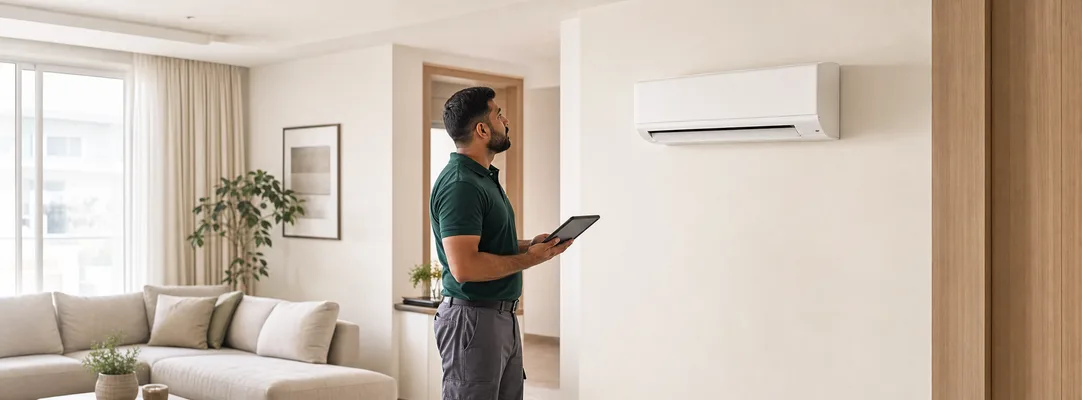
AC maintenance is most useful when it creates a clear record of how a system normally behaves. If cooling, airflow, sound, odour, drainage or controls later change, that baseline helps a resident describe the problem without guessing which component has failed.
Dubai homes use different air-conditioning arrangements, and responsibility may sit with the occupant, landlord, property manager or building operator. Routine observation cannot prevent every fault or guarantee lower bills, cleaner air, longer equipment life or uninterrupted cooling. It can, however, make gradual changes easier to recognise and give the correct service contact better information.
Identify the AC system and responsibility
First record whether the property uses wall-mounted split units, window units, concealed or ducted indoor units, fan-coil units, or a central or shared building system. Use the thermostat, visible model label, tenancy inventory, handover documents, previous visit notes or building-management information. Do not remove a cover or enter a service area just to identify equipment.
Also confirm which units serve which rooms, whether outdoor or shared equipment is building-controlled, who approves contractor access and whether a maintenance agreement already exists. A thermostat inside an apartment does not necessarily mean that every part of the system belongs to the occupant.
QuickFix reviews the system type and reported symptoms within its appliance category, then confirms whether the system and requested work fall within the current service scope before scheduling.
Address urgent warning signs first
Stop using the affected unit where it is safe to do so and seek the appropriate emergency, building or technical support if there is fire, smoke, serious sparking, electric shock, a strong burning smell, unusual heat around an electrical control, or water reaching electrical equipment. A repeated circuit-breaker trip, major spreading leak, visibly damaged unit or ceiling that appears swollen or unstable also needs prompt attention.
Do not touch wet equipment, remove an electrical cover, repeatedly reset a breaker or stand beneath an unstable ceiling. Keep children and pets away from the affected area. If someone has received an electric shock, contact the appropriate medical or emergency service and do not touch the equipment again.
A routine online booking is not an emergency response. For a repeated electrical trip, use the Dubai circuit-breaker warning-sign guide to record the event without recreating it, and request electrical repair when a fixed circuit, switch or other property fitting appears involved.
Create a useful performance baseline
A baseline is a short description of normal operation; it does not require technical instruments or internal access. For each room or unit, record:
- Unit or thermostat location
- Normal operating mode and selected setting
- Which doors and windows are usually closed during cooling
- Where airflow is normally noticeable
- Normal operating sound and cycle pattern
- Any usual difference between rooms
- Previous water marks, alerts or service notes
Compare performance under similar conditions; open doors, occupancy, sunlight and heat-producing activity can change the result. Record any existing thermostat or household-thermometer reading without treating one number as a diagnosis.
Record cooling and airflow changes
Describe the affected room and unit rather than saying only that “the AC is weak.” Note whether one room differs from the others, cooling takes longer than normal, airflow feels reduced or uneven, the unit appears to run differently, a louvre or user-facing control does not respond, or a display shows an error.
Record the selected setting, time, room conditions and when the change began. Do not repeatedly lower the thermostat or restart the unit to test it. Do not assume weak cooling means refrigerant must be added; airflow and cooling symptoms can have several possible explanations and require system-specific assessment.
Document water and drainage symptoms
Visible water near an AC may require appliance, plumbing or building review depending on the installation and location. Record the room or unit, first date noticed, whether the water drips, pools or appears as a stain, when it occurs, the approximate area affected and whether a ceiling, wall, cabinet, floor or neighbouring property is involved.
Do not open a drain connection, insert wire, apply chemicals, remove a ceiling panel or improvise a container near electricity. A stain does not by itself confirm an AC drain blockage. Move belongings from a nearby dry area when safe, keep people away from slippery surfaces and report a shared or spreading leak promptly.
Water near electrical equipment or an unstable ceiling needs urgent support. A wider fixed drainage concern may also need Plumbing Services or building management rather than an AC-only visit.
Note sounds and odours without diagnosing
Compare new sounds with the unit’s own normal baseline. Record whether rattling, buzzing, repeated clicking, vibration, whistling or an alarm occurs at startup, during operation or at shutdown. A short video is useful only when the sound occurs naturally and recording it is safe; do not repeatedly start the unit or remove a cover to reproduce it.
Describe an odour in plain language and note whether it begins with the AC or remains when the system is off. Smoke, burning smell or unusual heat is a stop-use warning. For another persistent odour, do not spray chemicals into vents, mix cleaning products or make a mould or indoor-air-quality diagnosis from smell alone.
Follow model-specific filter guidance
Some systems have filters intended for occupant access; others place them behind restricted covers, ceiling panels or service areas. Only remove, clean or replace a filter when the exact manual or building guidance identifies it as user-accessible, provides the procedure and does not require a ladder, disassembly or unsafe electrical access.
DEWA’s current cooling guidance recommends keeping filters clean as part of efficient AC use. The correct method and timing still depend on the installed filter, manufacturer instructions, property conditions and building arrangement.
Never run a unit without its required filter, force an incorrect replacement into place or apply an unapproved chemical. Record the filter type, date and action in the maintenance log. If access is unclear or restricted, leave it for the responsible building or service team.
Record controls consistently
Before comparing performance, note the selected mode, fan setting and any active timer. The same DEWA guidance recommends 24°C or higher; record the setting actually used, but do not treat one setting as a diagnostic test or substitute for individual requirements.
Route apartment, villa and shared-system requests correctly
In an apartment, contact building management when several units or apartments are affected, a chilled-water or central system may be involved, water reaches a common area, ceiling or shaft access is required, or a registered contractor or permit is needed. A tenant should check the lease, inventory and landlord process before authorising work on supplied equipment.
For a villa, identify the indoor units and ordinary safe access points, but do not climb to roof equipment, enter restricted external areas or lean over a balcony to photograph a condenser. Exterior, high-level and shared equipment require suitable access arrangements.
Tell the service contact about reception, parking, service-lift, permit and working-hour rules. These details may affect routing even when they do not identify the fault.
Keep an AC maintenance record
Create one record for each unit or controlled area. Include:
- Room served, system type, brand and model if known
- Landlord, occupant or building responsibility
- Normal settings and baseline observations
- User-accessible filter dates and actions
- Error codes with dated cooling, airflow, water, sound or odour notes
- Safe photos or short videos
- Previous assessment and service dates
- Written findings, confirmed work and part information
- Visit notes, invoices and any supplied follow-up terms
- Building request number and access requirements
Separate your observation from a provider’s written finding; do not save an unverified diagnosis as fact. A phone note, spreadsheet or labelled folder is sufficient if it is kept consistently. The wider annual home-maintenance checklist can organise AC records alongside plumbing, electrical and appliance tasks.
Know when a routine check becomes an assessment request
A routine request may be appropriate when the system appears stable and you want its current scope reviewed according to the manual, building rules or maintenance arrangement. Request an assessment sooner when cooling or airflow no longer matches the baseline, an error recurs, water appears, a new sound or odour develops, a control stops responding or an earlier concern returns.
Do not wait for a planned date when a condition is worsening or unsafe. This guide does not decide whether equipment should be repaired or replaced. If an assessment identifies recurring faults or a wider system decision, use the AC repair-versus-replacement guide. For non-AC equipment, see the common appliance problems guide.
Prepare the AC assessment request
For a contained, non-emergency concern, include:
- Dubai area, property type and building name
- Owner, tenant or authorised contact
- System type and affected room or unit count
- Brand, model and approximate age if available
- Normal baseline and exact observed change
- Control setting, error code or warning
- Cooling, airflow, water, stain, sound or odour details
- Date and time the symptom began
- Recent power interruption, renovation or service work
- Previous service history and safe photos or video
- Landlord and building approval requirements
- Access, permit, parking and preferred appointment window
Ask whether the visit is for routine review, cleaning, fault assessment or repair; which indoor, outdoor or shared equipment is included; whether parts or materials are separate; and how additional work will be approved. The cause, required work, compatible parts, final price and completion time may depend on the system and assessment.
A common AC maintenance question
How often should every AC be serviced?
There is no single interval that fits every system and property. Follow the exact manufacturer instructions, building rules, tenancy documents and any confirmed maintenance plan. Do not confuse an observation reminder with a universal technical-service schedule.
For a contained, non-emergency concern, review the QuickFix AC assessment guide or submit an AC assessment request.