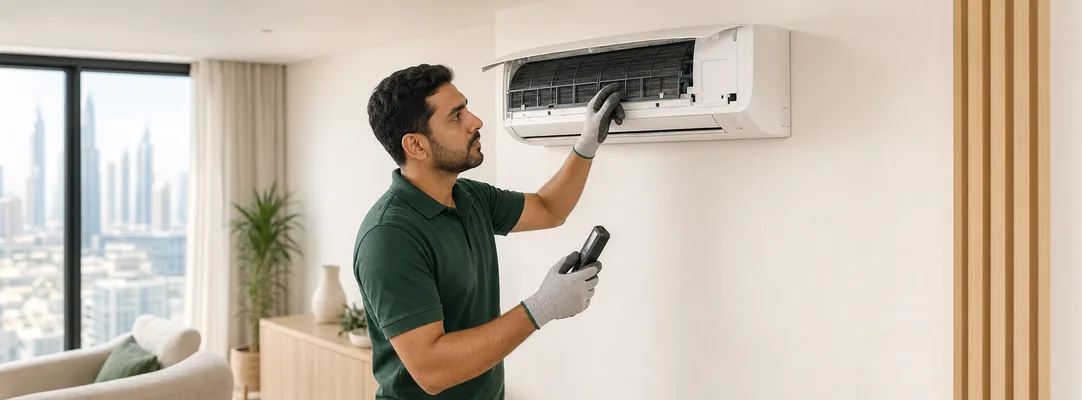
When an air-conditioning system stops cooling properly, replacement is not automatically the answer. A repair may resolve a clearly identified fault, while replacement may be worth comparing when problems are recurring, an important part is unavailable or the wider system is in poor condition.
For a Dubai apartment or villa, the decision can also depend on the AC system type, who is responsible for it, building access rules and whether any equipment is shared. Start with safety, confirm the correct service route and obtain an assessment before comparing repair and replacement.
Address urgent warning signs first
Stop using the affected unit and contact the appropriate building, emergency or technical support if there is smoke, a burning smell, serious sparking, visibly damaged electrical equipment or water reaching electrical controls.
Do not touch wet switches or equipment, remove AC covers, reach into moving components or attempt refrigerant, wiring or internal drainage work. Do not repeatedly reset a breaker that keeps tripping. If the home cannot remain at a safe temperature while the system is unavailable, move to a suitably cooled place and arrange the appropriate support.
Identify the AC system and who manages it
Dubai properties may use split units, ducted split systems, window units, fan-coil units connected to chilled water, or another central or shared arrangement. The correct assessment and approval route can differ between them.
Record the system type if known. A safely accessible model label, thermostat photo or previous service record may help. Do not move equipment or open a panel to find a label.
For an apartment, ask reception, the landlord or building management whether the affected equipment is maintained inside the unit or as part of a shared system. Building coordination is especially important when:
- Several rooms, apartments or common areas are affected
- A central control or chilled-water supply may be involved
- Water is appearing from a ceiling or shared service area
- Roof, balcony or plant-room access is required
- The property has approval rules for external equipment
These signs do not confirm where the fault is located. They show that shared access or information may be needed. A tenant should document the symptom and obtain any required owner or property-manager approval before authorising replacement work.
Describe the symptom without guessing the fault
A useful AC request explains what has changed instead of naming an unconfirmed failed part. Record:
- Which room, zone or unit is affected
- Whether airflow is weak or the air is not cool
- Whether the problem is constant or intermittent
- When the change was first noticed
- Any error code or warning light
- Unusual rattling, clicking, vibration or smell
- Water dripping or a new damp mark
- Whether a breaker has tripped
- Any recent maintenance, power interruption or renovation work
Mention whether one unit or the whole property is affected. Photos of the thermostat, a visible water mark and a safely accessible model label can provide useful context. A short video may help document a repeatable sound, but do not keep running the unit if doing so appears unsafe or worsens the issue.
These observations do not establish the cause. They make the initial review more focused and help the service team identify which questions to ask.
Complete only safe user-level checks
Check that the thermostat is using its normal cooling mode and that doors and windows are in their usual positions. If the manufacturer identifies a filter as user-accessible, follow its instructions and the building rules.
Do not add refrigerant, dismantle a drain line, open an electrical panel or place an improvised tool inside the unit. A recurring trip, leak or internal fault needs the appropriate assessment.
For routine observations and record keeping, read Why Regular AC Checks Matter in Dubai. That guide covers gradual performance changes and user-accessible maintenance; this article focuses on the later repair-or-replacement decision.
Get an assessment before comparing options
Ask the service provider to explain what was checked, what condition or fault was found and whether another cause still needs to be ruled out. The assessment should distinguish the reported symptom from the work being proposed.
Useful questions include:
- Which component or system condition is linked to the problem?
- Is the issue limited to one part or does it affect the wider installation?
- What work is proposed and what outcome is expected?
- Are suitable parts currently available?
- Does the same issue appear in the previous service history?
- Is any building-managed equipment involved?
- What further work could become necessary after access or testing?
Avoid choosing from a generic online price table alone. Similar symptoms can involve different systems, access requirements and repair scopes.
When repair may be the practical option
Repair may be reasonable when the assessment identifies a contained fault, the rest of the system is in serviceable condition and a suitable part is available. It may also make sense when the unit has not developed a pattern of repeated problems and the proposed work has a clear scope.
Before agreeing, request written details covering:
- The reported condition and assessed fault
- The part and labour being proposed
- Any diagnostic or visit charges
- Materials included in the confirmed work
- Access, parking or building charges where applicable
- The approval process for additional work
- Applicable parts and labour warranty terms
- Expected scheduling and unit downtime
Do not assume that every repair includes the same warranty. Ask who provides each warranty, what it covers, how long it applies and how a later claim would be handled.
When replacement deserves comparison
Replacement may be worth comparing when the system has recurring faults, several important components have deteriorated, a necessary part is unavailable or the equipment no longer suits the property after an appropriate assessment.
Other relevant questions include:
- Have previous repairs addressed the same recurring issue?
- Is there evidence of wider damage or deterioration?
- Is manufacturer support or a compatible part available?
- Would a repair leave another known major issue unresolved?
- Does the proposed equipment suit the room and installation?
- How long does the owner expect to use the property?
- What approval and installation work would replacement require?
Age is useful context, but it should not be treated as an automatic cutoff. Two units of the same age can have different installation conditions, service histories and faults. Likewise, a single repair-price percentage is not a reliable rule for every system.
Compare the complete replacement scope
The advertised price of an AC unit may not represent the complete installed scope. Ask a replacement quotation to identify, where relevant:
- The exact manufacturer and model
- The proposed cooling capacity and how it was selected
- Which indoor and outdoor components are included
- Thermostat or control compatibility
- Required piping, insulation, drainage or electrical work
- Brackets, supports or vibration control
- Duct or ceiling changes
- Access equipment, permits and building coordination
- Protection and making good of affected finishes
- Removal and responsible disposal of old equipment
- Testing and commissioning
- Product and installation warranty terms
A larger-capacity unit is not automatically a better choice. Capacity and compatibility should be determined for the property and existing installation by an appropriate provider.
For apartment work, confirm lift booking, parking, contractor access, work-hour restrictions and permission for external equipment before accepting a schedule.
Treat efficiency claims carefully
A newer unit may have different efficiency information, but a specific electricity-bill reduction cannot be assumed without evidence relevant to the property. Electricity use can also be affected by thermostat settings, occupancy, insulation, air leakage, duct condition, maintenance and the wider building system.
Ask for the proposed model documentation and compare compatible efficiency information on the same basis. Also ask whether the existing controls, ducts, electrical supply and building system allow the equipment to operate as intended.
Compare written quotations on the same basis
A low headline price may exclude work included elsewhere. Place repair and replacement options side by side and compare:
- The assessment or reason for the proposed work
- Exactly what equipment, parts and labour are included
- Work specifically excluded
- Possible additional costs and their approval process
- Access and building-management requirements
- Expected downtime
- Parts, product and workmanship warranty terms
- Removal, cleanup and making-good responsibilities
- Payment stages and quotation validity
If two providers describe different conditions or substantially different scopes, ask for clarification before making the decision.
Keep ownership and future plans in view
An owner planning to remain in a property may evaluate replacement differently from a tenant approaching the end of a lease. However, short-term plans should not override safety, property rules or the owner's responsibilities.
Tenants should keep the fault report, photos and communication with the landlord or property manager. Owners should retain the assessment, quotation, model information, invoices and warranty documents. These records are useful if performance changes again.
Add the AC details to the practical home maintenance checklist for Dubai residents so later symptoms can be compared with earlier observations.
Information to send with an AC request
For a non-emergency assessment, include:
- Property type and Dubai area
- Apartment, villa or building access details
- AC system type, if known
- Number of affected rooms or units
- Brand, model and approximate age, if available
- A clear symptom timeline
- Error codes, visible water or unusual sounds
- Previous repair or service history
- Landlord or building-management contact requirements
- Photos or a short video taken without opening equipment
QuickFix reviews AC requests within its appliance category and confirms whether the system and reported work fall within the current service scope before scheduling.
Review the QuickFix AC assessment guide or submit an AC assessment request.