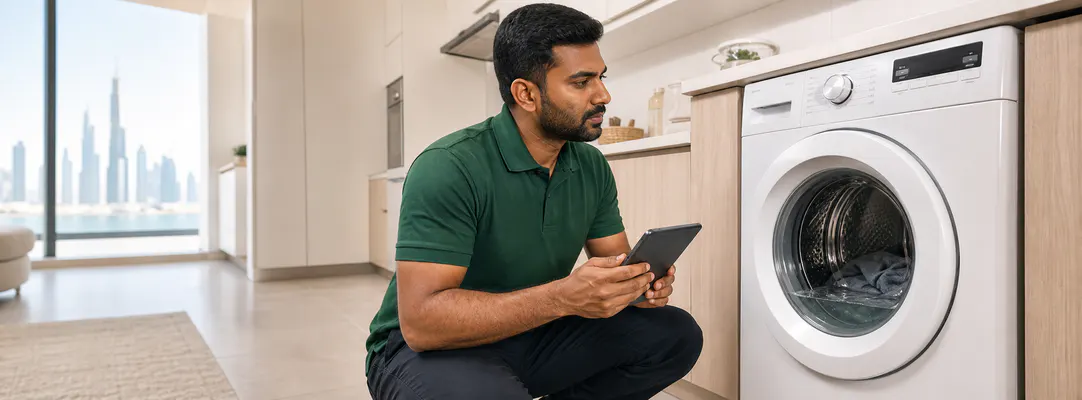
A washing machine that stops with water inside has a clear symptom, but the visible water does not identify which component or connection is responsible. The relevant details can depend on the model, selected programme, installation, displayed message and whether another household drain is also affected.
You do not need to diagnose the fault before requesting help. Record what happened, stop running additional cycles and follow only the user guidance supplied for the exact model.
QuickFix reviews suitable non-emergency requests through Appliance Repair in Dubai. This guide focuses specifically on a machine that does not complete its drainage stage. The wider guide to common appliance problems covers other symptoms such as failure to start, unusual movement, loss of power and heating concerns.
Check for urgent warning signs first
Standing water inside the drum is different from water spreading across the floor or reaching electrical equipment. Stop using the machine and move away from the area if there is:
- Fire, smoke or serious sparking
- An electric shock or tingling sensation
- A strong burning or melting smell
- Unusual heat around the plug, socket, cable or controls
- Water approaching a socket, extension lead or powered equipment
- Rapidly spreading water that may affect another room or property
- Violent movement, instability or visible physical damage
- Wastewater or another potentially contaminated overflow
- A ceiling, wall or electrical fitting affected by water
- Any immediate danger to occupants or the building
Contact the appropriate emergency, utility or building support when there is an immediate risk. An online appliance booking is not an emergency response.
Do not touch wet electrical equipment, stand in spreading water or approach a damaged socket. Keep children and pets away. If someone has received an electric shock, seek the appropriate medical or emergency assistance and do not touch the appliance again.
Confirm the exact drainage symptom
Describe what the washing machine does rather than naming a part that may have failed. Useful observations include:
- The programme stops with visible water in the drum
- The display remains on a drainage stage
- Clothes remain in more water than expected
- The machine shows an error message
- A new humming, clicking or another sound occurs
- The programme ends but the drum still contains water
- The issue happens on one selected programme or more than one
- The problem began after the appliance was installed or moved
- Water appears outside the machine during the same stage
These observations do not establish whether the condition involves the machine, its installation, a connected drainage route or another factor. Avoid describing the pump, hose, filter or control system as defective unless that finding has been confirmed through an appropriate assessment.
Stop running additional cycles
Repeated programmes can add more water, reproduce a leak or place further demand on equipment that is not operating normally. Do not restart the same cycle simply to collect a video or see whether the machine will eventually drain.
Leave the appliance alone when water remains after the programme, an error returns, a new severe sound occurs, water appears outside, the controls do not respond normally or an electrical warning sign is present.
Do not force the door, tilt the machine or attempt to move it while it contains water. A water-filled appliance can be heavy and unstable, and movement may affect its connections or release water into the room.
Do not disconnect hoses, pull the appliance away from the wall or remove a surrounding cabinet to investigate. Keep the installation in its current position and explain any access restriction when submitting the request.
Record where the programme changes
A simple timeline is more useful than a guessed diagnosis. Write down:
- The selected programme
- The approximate stage at which it stops
- Whether washing and rinsing appeared to occur first
- What remains visible on the display
- The exact error code or message
- Whether the controls remain responsive
- Whether a new sound occurs before the stop
- Whether the issue happened once or has returned
- The approximate load type without removing wet items unsafely
- Any interruption to water or electricity during the cycle
Photograph the display from a normal safe position where practical. Do not continue operating the machine to make an error reappear.
Keep the model number and user manual available. Record any displayed message exactly rather than replacing it with a general description such as "drain fault."
Follow only the exact model manual
Washing-machine designs and user-maintenance procedures differ. Generic instructions found for another model may identify controls, access points or drainage arrangements that do not apply to your appliance.
Review only the manufacturer information for the exact model. Confirm whether the displayed message has a user-facing explanation and whether the manual identifies any normal control action or user-accessible maintenance procedure.
Do not open a panel, pump area or internal compartment because a generic guide suggests doing so. Do not remove a hose, reach into standing water or improvise a drainage method. Stop if the manufacturer procedure would require lifting, moving the appliance, approaching electricity, handling contaminated water or opening an area that is not clearly intended for routine user access.
If the correct manual is unavailable or the instructions are unclear, include that in the booking request. The absence of a safe user step is a reason to request assessment, not to substitute instructions from an unrelated model.
Note water outside the machine
If water is visible on the floor, describe where it first appears without pulling the appliance forward. State whether it is:
- Directly in front of the machine
- Beside one side
- Under an accessible cabinet edge
- Near a sink or fixed drain
- Spreading toward another room
- Close to a plug, socket or electrical fitting
- Clear-looking or potentially contaminated
The visible location alone does not show where the water originated. It may relate to the appliance, an accessible connection, fixed plumbing, a nearby drain or another source.
Move dry belongings away only when this can be done without approaching electricity or unstable equipment. Do not apply chemicals, sealants or improvised patches, and do not loosen a connection to search for the leak.
If water is near a wall socket or the socket has stopped working, follow the Dubai power-socket warning guide and use the appropriate urgent support where there is heat, sparking, shock or another immediate electrical danger.
Check whether another household drain is affected
A washing machine drainage symptom may appear at the same time as a slow sink, floor drain or another connected appliance. Note whether you had already observed:
- Slow drainage from a nearby sink or utility outlet
- Gurgling from another fixture
- Water rising in a floor drain
- An unusual drainage smell
- More than one fixture failing to clear
- A recent building drainage notice
- Similar problems reported elsewhere in the property
Do not run additional taps or appliances to test the wider drainage system. Recreating a blockage can cause an overflow or spread contaminated water.
When several fixtures are slow or backing up, use the blocked-drain guide for Dubai apartments to document the pattern. A fixed or shared drainage concern may need Plumbing Services, building management or another appropriate contact rather than an appliance-only visit.
Consider recent installation or property work
Include any recent appliance delivery, installation or movement; plumbing or drainage work; cabinet work around a built-in machine; power interruption; renovation; or another appliance being connected nearby.
These events are useful context, not proof of a cause. Do not move the machine back to an earlier position or alter its connections in an attempt to reverse the problem.
Tenants should report concerns through the relevant landlord or property-management process, particularly when the appliance belongs to the property or a shared drainage route may be involved. Apartment residents may also need contractor registration, parking approval, lift access or permitted working hours.
Prepare the appliance repair request
For a contained, non-emergency problem, include:
- Dubai area, property type and building name
- Washing-machine type, brand and model
- Whether it is freestanding, built in or stacked
- The selected programme and stage where it stops
- Exact error code or display message
- Whether water remains inside the drum
- Whether any water is visible outside the machine
- Any new sound, smell, heat or movement
- Whether a breaker trip or socket problem occurred
- Whether another sink or drain is also affected
- Recent appliance movement, installation or plumbing work
- Photos of the display and surrounding area when safe
- Whether the correct model manual is available
- Access restrictions around the appliance
- Building permits, parking and working-hour requirements
- Preferred appointment date or time window
A requested date remains a preference until confirmed. The cause, required work, parts, price and completion time may depend on the appliance, installation and on-site findings.
Keep the area ready for assessment
Leave the appliance in place and stop normal use. Keep people away from visible water and avoid storing items against the machine or blocking the normal route to it.
Do not empty the appliance into another household drain when the wider drainage route may also be affected. Do not conceal an error, leak, electrical trip or temporary action taken before the visit; those details can be important to the assessment.
Keep the manual, model details, installation information and earlier service notes available. The annual Dubai home-maintenance checklist can help retain the confirmed findings and any related plumbing or electrical records after the issue has been reviewed.
The safest response is to stop additional cycles, document the exact drainage stage, follow only model-specific user guidance, avoid moving or opening the machine and report any wider drainage or electrical warning signs.
Review the washing-machine repair guide or submit a washing-machine repair request.